The Law of Asymmetry
An empire's strengths become its fatal weaknesses.
| Strength (early) | Decays into | Terminal weakness |
|---|---|---|
| Mass — endless people & vassals | competition → inequality → debt | A population unwilling to fight |
| Organization — bureaucracy, tech, weapons | rent-seeking → too many elites | Factionalism & infighting |
| Death — can absorb any losses | no consequences → arrogance | Hubris (repeats its mistakes) |
What it says
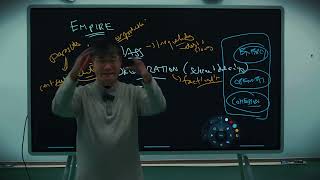
An empire wins early because of mass (limitless people), organization (bureaucracy, science, the best weapons) and death (it can absorb any losses and come back for more). But, Jiang argues, each of those strengths decays into a terminal weakness: mass breeds inequality and an unwilling-to-fight population; organization breeds elite overproduction — too many elites competing for too few seats — which curdles into factionalism; and the freedom to absorb losses breeds hubris, "blindness to your own arrogance." The underdog wins only if it develops the three antidotes — energy, openness, cohesion. The cruel twist: the empire's own optimal tactics tend to manufacture those antidotes in its enemy.
The paradox: every tactic backfires
Jiang's sharpest claim is that the empire's smartest moves create the enemy that beats it. Decapitation — killing the enemy's leaders — solves the underdog's elite-overproduction problem for it, leaving leaner, more meritocratic leadership. Carpet-bombing cities erases the enemy's internal divisions, uniting secular and religious behind a single cause. Arming ethnic minorities reawakens the majority's wounded nationalism. Each escalation adds energy, openness, or cohesion to the other side.
America's own strengths are self-defeating
He runs the same logic on the United States: its three modern strengths — technology, propaganda, money — each rot. Technology breeds dependency and laziness; propaganda breeds censorship, which kills the rigorous debate a state needs ("getting high on your own supply"); money breeds mercenaries who scam the paymaster. He pairs this with three concrete U.S. weaknesses in a real war: a lack of political will, a hollowed-out manufacturing/logistics base, and an inability to absorb casualties.
In Jiang's words
“All these advantages are ultimately disadvantages in the long term. The mass leads to inequality, the organization leads to overproduction and factionalism, and death leads to hubris. That's why an empire must fall over time.”— GT#10
“An empire cannot fall by itself. It needs an enemy that forces it to collapse.”— GT#10
“If an enemy emerges with these three qualities — energy, openness, and cohesion — this enemy will defeat the empire.”— GT#10
“Hubris is blindness to your own arrogance — it makes you make silly mistakes, but you don't recognize them, so you keep repeating them.”— GT#10
Where he applies it
- Historical underdogs: the Greeks against Persia, the Macedonians under Alexander, Rome from a single tribe.
- The U.S.–Iran war as the central case — why he forecasts the larger power loses.
- A classroom analogy: relying on ChatGPT makes a student lazier and dumber, the way advanced weaponry makes a military complacent.
What it predicts
From the Law of Asymmetry, Jiang forecasts:
- The United States will lose its war with Iran.
- A U.S. ground invasion would mean the U.S. has already lost — the country is “impossible to occupy.”
Tracked predictions from this framework
Live predictions on this site that this framework generated — their status updates automatically as events resolve.
Updates
Tracked prediction P015 — “Shock and Awe will fail in Iran,” the clearest test of this law — has been confirmed by events. P018 (the war will last weeks-to-years) and P011 (the U.S. goes to war with Iran) are also confirmed.
Related frameworks
Watch the source lectures
This framework is one of several behind 450 tracked predictions — 22 already resolved.
← All frameworks