The Law of Escalation
Control beats dominance — calibration wins wars.
What it says
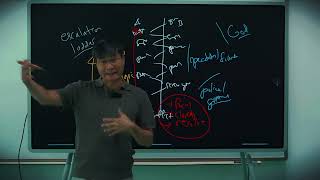
Jiang refutes the idea that escalation dominance — having the biggest weapon — decides a conflict. What wins, he argues, is escalation control: calibration, the strategic flexibility of the player with the most options, who climbs the ladder deliberately while staying "the good guy" before every audience. A fight is never contained to the two fighters; it is watched by spectators, by the state, and (he says) by God, and you must justify each move to all of them. You cannot skip rungs — adrenaline forces a step-by-step climb — and overreacting makes you the guilty party. The disciplined player stays calm, preserving three faculties: focus, clarity, resolve.
You cannot skip rungs
Three forces push people up the ladder — emotions, power, and reason — with adrenaline as the physical engine. Adrenaline makes you angrier, stronger, more resolved, and it forces the climb to be step-by-step: you escalate from a curse to a shove to a punch to a weapon, never leaping straight to the top. The strategic consequence is that you can read where a conflict is, and you can manipulate an over-reactive opponent into climbing too fast and becoming the villain.
Every rung is fought on four fronts
The military dimension, Jiang insists, is the least important. Every escalation is simultaneously a move in four games, ranked by importance: narrative (world opinion) above political (state-to-state and state-to-people) above economic (ongoing trade) above military. “Your purpose is to control the narrative.”
The cost pyramid forces ground troops
A healthy military is a pyramid — cheap infantry at the base, then armor and artillery, then navy, then expensive air power at the tip. The U.S., he argues, has an inverted pyramid: air-dominant, light on infantry. You cannot fight a real war of attrition with an inverted pyramid, so the U.S. is eventually forced back to ground troops — and a draft.
The new kid and the bully
His teaching parable: a new student refuses to pay the cafeteria bully's “tax” and ignores every provocation. The bully must escalate to protect his credibility, finally throws a punch — and in beating a smaller, calmer opponent, reveals he is not so strong, and the school unites to topple him. The bully has dominance but no options; the new kid has calibration. Map it: Iran is the new kid, the U.S. is the bully, the Gulf states are the watching school.
In Jiang's words
“Control is more important than dominance. Control is calibration — you time and structure your response to achieve your strategic objective.”— GT#11
“It's impossible to skip the escalation ladder. You have to go step by step by step, because adrenaline is rushing through your system.”— GT#11
“Calibration is ultimately about strategic flexibility. In a fight, the person with the most options will usually win.”— GT#11
“You must follow this escalation ladder if you are to use nuclear weapons. Unless I see biochemical weapons being used, I refuse to believe nuclear weapons are on the table.”— GT#11
“The military dimension is probably the least important. Your purpose is to control the narrative.”— GT#11
Where he applies it
- The U.S.–Iran war, read as two ladders with very different ceilings.
- Why Iran closing the Strait of Hormuz selectively — letting Chinese ships through — is calibration, not just aggression.
- Mission creep, Vietnam-style: 1,000 troops become 2,000 become a trap.
What it predicts
Jiang staked his whole model on getting three Game Theory #11 calls right — “if I miss one, my theory is wrong”:
- YES — the U.S. will be forced to send in ground troops (and call a draft).
- NO — nuclear weapons will not be used (the ladder hasn't reached the bio/chem rung).
- YES — the Al-Aqsa Mosque will eventually be destroyed (the analysis he carries into the Law of Eschatological Convergence).
Tracked predictions from this framework
Live predictions on this site that this framework generated — their status updates automatically as events resolve.
Updates
Several lower rungs of the U.S. ladder are already confirmed in the tracker: P012 (bombing nuclear facilities), P088 (decapitation strike), P026 (Iran closes Hormuz), P027 (Iran attacks GCC states). His “no nukes” call (P016) is holding up so far; the ground-troops and Al-Aqsa rungs remain pending.
Related frameworks
Watch the source lectures
This framework is one of several behind 450 tracked predictions — 22 already resolved.
← All frameworks