| Nation | King · political system | Queen · grand strategy | Attack vectors | How to check it |
|---|---|---|---|---|
| United States | Democracy | Greater North America — a continental fortress | Tech, the dollar, propaganda | Force it into civil war via polarization |
| Russia | Autocracy | Third Rome — heir to Rome & Constantinople | Orthodoxy, geography, artillery | Outlast Putin → a succession crisis |
| Iran | Theocracy | Shia exceptionalism — lead the Muslim world | Terrain, faith, proxies | Provoke extremism that splits the public |
| Israel | Democracy + theocracy | Greater Israel — Nile to Euphrates | The Bible, Mossad, the diaspora | Trigger civil war in a fractured society |
What it says
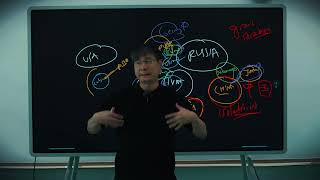
Each country is a chess set, in Jiang's framework: the king is the political system (the thing you actually attack); the queen is the grand strategy (the most powerful, mobile piece — how the nation intends to dominate); the bishop, knight and rook are attack vectors (the tools — technology, money, religion, proxies); and the pawns are sacrificial. You win not by destroying the enemy's military but by putting its king in check — attacking its political system. Crucially, grand strategy is also a constraint: a nation can only act within the contours of its own strategy, which is what makes its behavior predictable.
Who even counts as a player
Population and GDP don't make a country a player, Jiang argues — a galvanizing grand strategy that can mobilize the population for total war does. By that test only four nations qualify (the U.S., Russia, Iran, Israel). He pointedly excludes China and India: China is "the Middle Kingdom," culturally isolationist, and "does not do grand strategy," so he expects it to drift back toward isolation rather than drive the global contest.
Why no one wins quickly
Because each player's grand strategy is internally coherent and self-galvanizing, none can be checkmated fast — you can only maneuver. Jiang expects the four-way contest to drive geopolitics for five to ten years, spreading outward to pull in opportunist secondary players (he names North Korea, Poland, Turkey) and re-armed proxies (Germany, Japan).
In Jiang's words
“Imagine each country as a chess set. The king is the political system, the queen is the grand strategy, the bishop, knight and rook are the attack vectors, and the pawns are sacrificial tools.”— GT#23
“When you fight a war, you're not trying to defeat the other person's military. What you're really trying to do is put your opponent in check by attacking the political system.”— GT#23
“Grand strategy is not only how a nation goes out to dominate the world — it's also a constraint. They can only operate within the contours of their grand strategy.”— GT#23
“China does not do grand strategy. China is the Middle Kingdom — a universe unto itself; it doesn't care what happens outside.”— GT#23
Where he applies it
- The U.S. arming proxies — Israel vs. Iran, Germany vs. Russia, Japan vs. China — as pawn-and-vector play.
- Russia “not afraid to lose soldiers” in Ukraine as the pawn doctrine in action.
- Reading Israel's internal fractures as the way to “check” it without firing a shot.
What it predicts
From the Chessboard, Jiang forecasts:
- No single player wins; a four-way conflict drives geopolitics for 5–10 years and spreads worldwide.
- America is attacked through induced civil war, not militarily; Russia through a manufactured succession crisis.
- Germany and Japan re-arm as U.S. proxies; North Korea, Poland and Turkey rise as opportunists.
Tracked predictions from this framework
Live predictions on this site that this framework generated — their status updates automatically as events resolve.
Related frameworks
Watch the source lectures
This framework is one of several behind 450 tracked predictions — 22 already resolved.
← All frameworks